
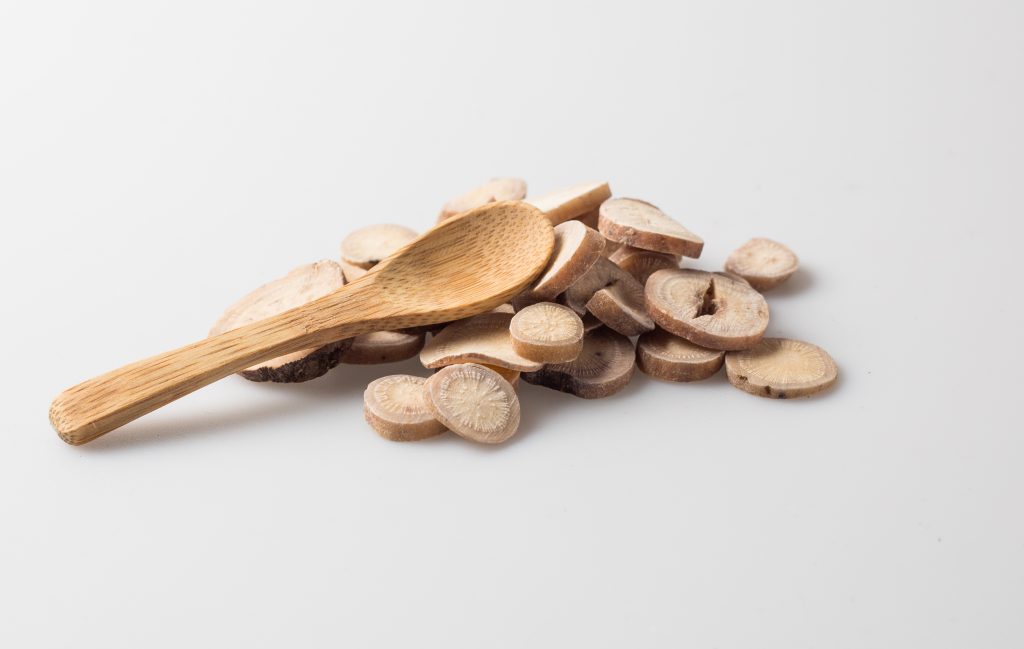
The phrase “kwao krua” can be confusing because it is a traditional Thai common name applied to more than one plant. Research comparing the three botanicals confirms that white, red, and black Kwao Krua have different botanical identities and chemical profiles. A botanical authentication study published in the Journal of Natural Medicines specifically examined how the three can be distinguished.
That distinction matters when shopping for an extract. A product labelled only with a common name may not tell you enough about the underlying plant. For formulators, botanical identification is even more important because the plant identity determines which research, specifications, safety information, and traditional context are relevant.
| Common name | Botanical identity | Plant family | Traditional context |
|---|---|---|---|
| White Kwao Krua | Pueraria mirifica | Fabaceae | Traditionally associated with women’s wellness and rejuvenating preparations |
| Red Kwao Krua | Butea superba | Fabaceae | Traditionally associated with men’s vitality and rejuvenating preparations |
| Black Kwao Krua | Mucuna collettii | Fabaceae | Traditionally associated with men’s vitality and rejuvenating preparations |
The traditional associations in this table describe historical herbal use, not a recommendation or a prediction of what a modern supplement will do.
Is Kwao Krua the Same as Pueraria Mirifica?
Not exactly. Kwao Krua is a broader common-name term, while Pueraria mirifica is the botanical name of the plant commonly called White Kwao Krua. Current botanical databases maintained by the Royal Botanic Gardens, Kew recognize Pueraria mirifica as an accepted species and list Pueraria candollei var. mirifica as a synonym. Kew’s Plants of the World Online record provides the current taxonomic context.
In practical terms, when an English-language product or article refers to “White Kwao Krua,” it is commonly referring to Pueraria mirifica. This is the Kwao Krua type that is particularly important when discussing naturally occurring phytoestrogens.
Pueraria mirifica contains naturally occurring compounds including isoflavones and distinctive chromene compounds. A recent peer-reviewed review describes the plant as a source of phytoestrogenic compounds and highlights challenges involving botanical authentication, chemical variation, standardization, and safety. The 2026 review in Frontiers in Pharmacology provides a current overview of this evidence.
So, if your search starts with “kwao krua” and your goal is to understand Pueraria mirifica, look specifically for White Kwao Krua or the botanical name Pueraria mirifica rather than assuming that every Kwao Krua product contains the same plant.
What Is White Kwao Krua?
White Kwao Krua is the common Thai name most closely associated with Pueraria mirifica, a climbing plant native to Thailand and belonging to the legume family Fabaceae. Its underground root or tuberous root is the plant material traditionally associated with herbal preparations.
What makes White Kwao Krua different from the other Kwao Krua types is its phytochemical profile. Pueraria mirifica contains phytoestrogens, a group of naturally occurring plant compounds with estrogen-like activity. This is a fundamental botanical distinction and should not be transferred to red or black Kwao Krua simply because they share the same Thai common name.
Research has also shown why authentication matters. White Kwao Krua products can be difficult to distinguish visually after processing, and studies have developed molecular and chemical approaches to differentiate Pueraria mirifica from red and black Kwao Krua. A Journal of Natural Medicines study examining products sold in Thailand reported the use of molecular, chemical, and microscopic analyses for authentication.
For a closer look at the plant itself, see the existing Pueraria mirifica botanical overview.
What Is Red Kwao Krua?
Red Kwao Krua refers to Butea superba, a completely different botanical from Pueraria mirifica. It is a Thai plant in the Fabaceae family and is traditionally associated with men’s vitality in Thai herbal practice.
Modern research on Butea superba has examined its phytochemistry, traditional applications, and potential biological activity. Human research exists, but that evidence should be considered separately from research on White Kwao Krua because the plants are chemically different.
A review of plants used traditionally for sexual performance describes Butea superba as Red Kwao Krua and discusses both traditional use and preclinical and human research. The peer-reviewed review in Evidence-Based Complementary and Alternative Medicine also discusses toxicological findings, illustrating why the safety profile of one Kwao Krua should not automatically be applied to another.
For readers specifically researching Red Kwao Krua, Oriental Heritage Herbalists also has a dedicated Butea superba, or Kwao Krua Dang, overview.
What Is Black Kwao Krua?
Black Kwao Krua is associated with Mucuna collettii, a Thai legume traditionally associated with male rejuvenating preparations. Botanical literature has also treated Mucuna collettii as a synonym of Mucuna macrocarpa var. macrocarpa, so formulators should pay attention to the botanical nomenclature used by their supplier.
The important point is that Black Kwao Krua is not simply a darker version of White Kwao Krua. It is a different botanical material with its own chemistry and research history.
Studies comparing White, Red, and Black Kwao Krua have specifically identified Mucuna collettii as the black type and demonstrated that the three botanicals can be differentiated using molecular techniques. The PCR-RFLP study published in the Journal of Natural Medicines is useful background for understanding why common names alone can create confusion.
Black Kwao Krua Is Not Black Ginger
This is one of the most important naming distinctions for shoppers and AI search results. Black Kwao Krua and black ginger are not the same plant.
Black ginger is Kaempferia parviflora, a member of the ginger family Zingiberaceae. Its rhizome contains methoxyflavones that have been studied as characteristic compounds of the plant. A PubMed-indexed study on Kaempferia parviflora examined chemical markers in different types of the plant.
By contrast, Black Kwao Krua refers to a Mucuna botanical. The shared word “black” does not make these ingredients interchangeable.
If you are specifically looking for black ginger, see the existing Kaempferia parviflora Black Ginger article or explore the Kaempferia parviflora Premium Grade capsules.
Is White Kwao Krua for Men or Women?
White Kwao Krua has traditionally been associated more closely with women’s wellness, while Red and Black Kwao Krua have traditionally been associated with men’s vitality. This distinction appears in research comparing the traditional Thai rejuvenating herbs.
The reason White Kwao Krua needs separate consideration is its phytoestrogen content. Phytoestrogens are plant compounds that can interact with estrogen-related biological pathways. That makes Pueraria mirifica fundamentally different from simply choosing a botanical because its common name contains “Kwao Krua.”
That does not mean a botanical should be reduced to a simple “for men” or “for women” label. A person’s age, health circumstances, medications, goals, and the formulation itself can all matter. For product selection, the botanical identity should come first.
If your interest is specifically in White Kwao Krua as a finished product, Oriental Heritage Herbalists offers Pueraria mirifica Premium Grade capsules.
Can You Take Red and White Kwao Krua Together?
There is not enough evidence to assume that combining Red Kwao Krua and White Kwao Krua is appropriate for everyone. They are different plants with different chemical profiles, and the research on one should not be used to predict the effects or safety of the combination.
This is particularly relevant because Pueraria mirifica is a phytoestrogenic botanical, while Butea superba has a different phytochemical profile. Combining them simply because both are called Kwao Krua can therefore create an unnecessary assumption that they are complementary versions of the same herb.
If you are considering combining products, check the complete ingredient lists and speak with a qualified healthcare professional, especially if you are pregnant, breastfeeding, taking medication, or have a hormone-sensitive condition.
For readers comparing the two botanicals in more detail, see Butea Superba vs. Pueraria Mirifica: What’s the Difference and What’s the Same?.
How to Choose a Kwao Krua Extract
The simplest way to choose among Kwao Krua products is to stop at the botanical name before looking at the marketing description.
- Identify the plant. Confirm whether the ingredient is Pueraria mirifica, Butea superba, or Mucuna collettii.
- Check the plant part. Root, tuberous root, seed, or rhizome can indicate very different raw materials.
- Look for extract specifications. Formulators should review the extract ratio, standardization information, analytical specifications, and available quality documentation.
- Separate common names from botanical names. White, red, and black are useful traditional labels, but the scientific name provides much clearer identification.
- Match the evidence to the plant. Research on White Kwao Krua should not automatically be presented as evidence for Red or Black Kwao Krua.
For brands and formulators, these checks become especially useful when moving from small finished-product formats to larger ingredient programs. A clear botanical identity makes it easier to evaluate specifications and communicate accurately with customers.
How to Use the Information When Comparing Products
If you are a consumer, begin by deciding which botanical you actually want to investigate. Someone searching for a phytoestrogenic Thai botanical is asking a different question from someone researching Red Kwao Krua or Black Ginger.
If you are developing a product, start with the botanical identity and intended formulation rather than selecting a common name first. Ask for documentation that identifies the plant material and describes the extract. This approach can reduce the risk of confusing similarly named Thai botanicals.
Oriental Heritage Herbalists supplies Thai herbal extracts in finished and bulk formats for different formulation needs, including capsule products and botanical extracts for brands. The important starting point is always the correct plant.
Kwao Krua Safety: Why Botanical Identity Matters
Safety information cannot simply be transferred from one Kwao Krua to another. White, Red, and Black Kwao Krua are different botanicals, so their constituent profiles and research findings need to be considered separately.
For Pueraria mirifica, particular attention is appropriate because it contains phytoestrogens. A recent review also identifies variation in phytochemical composition, extraction, and standardization as important considerations when evaluating the plant. The 2026 Frontiers in Pharmacology review discusses these evidence and standardization issues in detail.
For Butea superba, published research has examined both human and preclinical contexts, as well as toxicological questions. This is another reason not to assume that information about White Kwao Krua applies to Red Kwao Krua.
For any of these botanicals, people who are pregnant, breastfeeding, taking medication, or living with a hormone-sensitive condition should speak with a healthcare professional before using a supplement containing the relevant extract.
Frequently Asked Questions About Kwao Krua
Is Kwao Krua the same as Pueraria mirifica?
No. Kwao Krua is a common-name term used for different Thai botanicals. White Kwao Krua is commonly identified as Pueraria mirifica, while Red Kwao Krua is Butea superba and Black Kwao Krua is associated with Mucuna collettii.
What is Red Kwao Krua?
Red Kwao Krua is the traditional Thai common name associated with Butea superba. It is a different plant from White Kwao Krua and has its own traditional use, chemistry, research, and safety considerations.
What is Black Kwao Krua?
Black Kwao Krua is associated with Mucuna collettii. It should not be confused with black ginger, which is Kaempferia parviflora.
Is White Kwao Krua for men or women?
White Kwao Krua has traditionally been associated more closely with women’s wellness, while Red and Black Kwao Krua have traditionally been associated with men’s vitality. White Kwao Krua also has a distinct phytoestrogenic profile, so product selection should consider the individual’s circumstances rather than relying only on gender labels.
Can you take Red and White Kwao Krua together?
There is not enough evidence to assume that combining them is appropriate for everyone. They are different botanicals, and White Kwao Krua has a phytoestrogenic profile. Anyone considering a combination should review the full formulation and consult a qualified healthcare professional when relevant.
Conclusion: Start With the Right Botanical Name
The most useful way to understand kwao krua is to separate the common name from the plant itself. White Kwao Krua is Pueraria mirifica, Red Kwao Krua is Butea superba, and Black Kwao Krua is associated with Mucuna collettii. Black ginger, meanwhile, is Kaempferia parviflora and is a separate botanical altogether.
Once the plant is correctly identified, it becomes much easier to evaluate traditional use, phytochemistry, safety information, extract specifications, and the appropriate product format. For consumers, that means making a more informed choice. For formulators, it creates a clearer foundation for sourcing and product development.
To explore the individual botanicals, see the Pueraria mirifica Premium Grade capsules, Butea superba Premium Grade capsules, and Kaempferia parviflora Premium Grade capsules.